VAT included for EU orders.
Shipping calculated at checkout.
Couldn't load pickup availability
Specs
Model
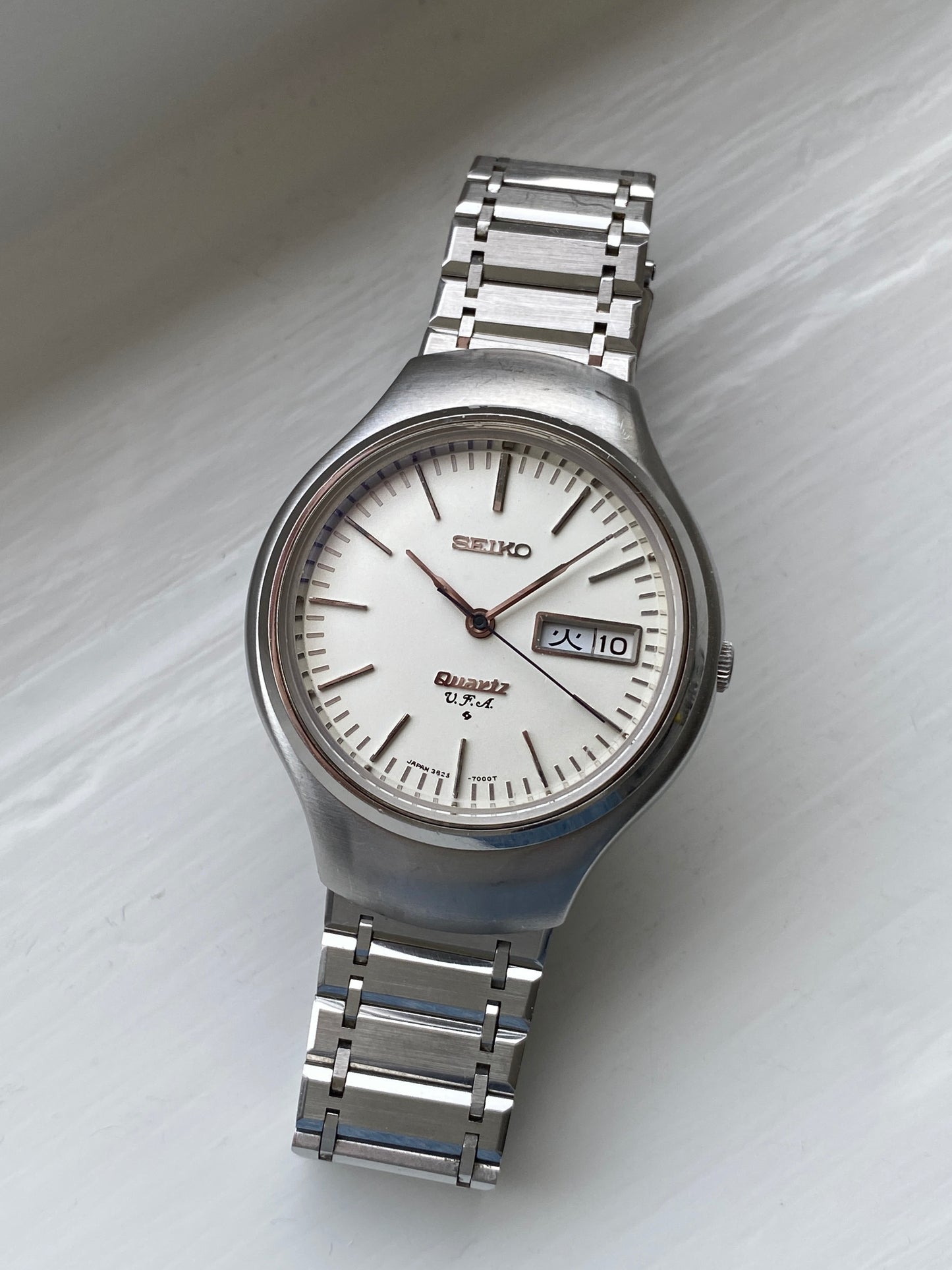
Seiko Quartz V.F.A.
Reference
3823-7000
Year
1973
Movement
Quartz
Case size
37mm
Lug width
16mm
Bracelet
XGB262
Wrist size
Fits up to 19 cm
Service
Fully serviced (February 2026)
Condition
Very good
Warranty
3 months
The watch This Seiko Quartz V.F.A. (‘Very Fine Adjusted’) is offered in excellent overall condition. It features a snow-white dial beneath a clear crystal, with a day-date window at 3 o’clock that can display in Japanese Kanji or English. The watch comes with its original stainless steel bracelet, fitting up to a 19 cm wrist.
The case, bracelet and crystal show minor signs of wear consistent with age. The dial is immaculate. The caseback shows marks from past opening.
The watch was fully serviced by a professional watchmaker in February 2026. The service included complete disassembly, cleaning, lubrication, and reassembly.
Details The 1970s marked the rise of quartz technology, which brought greater accuracy and lower maintenance compared to mechanical watches. The Seiko 3823-7001, powered by the 3823 quartz movement, reflects this advancement. Following the introduction of Seiko’s quartz Astron in 1969, models like this one made precise timekeeping widely available. Quartz watches offered durability and affordability, shifting the landscape of the watch industry. This piece is a functional relic from that transformative period.
The quartz crisis The "quartz crisis" was a major turning point in the watch industry during the 1970s and 1980s, driven by the rise of quartz technology. Companies like Seiko led the way, offering watches that were more accurate, more affordable, and easier to maintain than traditional mechanical models.
With the launch of the first quartz wristwatch, the Astron, in 1969, Seiko showed the world what quartz could achieve. Swiss watchmakers, known for their mechanical craftsmanship, were slow to react and lost much of their market share. The crisis forced the Swiss industry to restructure and helped shape a future where traditional watchmaking and modern quartz innovation could exist side by side.