VAT included for EU orders.
Shipping calculated at checkout.
Couldn't load pickup availability
Important holiday notice: orders will be shipped from August 1.
Specs
Model
Seiko King Seiko 45KS
Reference
45-7000
Year
1969
Movement
Manual wind
Dial
Tropical
Case size
36mm
Lug width
18mm
Bracelet
XGB061 (LM bracelet)
Accuracy
-6 seconds per day
Condition
Very good
Warranty
3 months
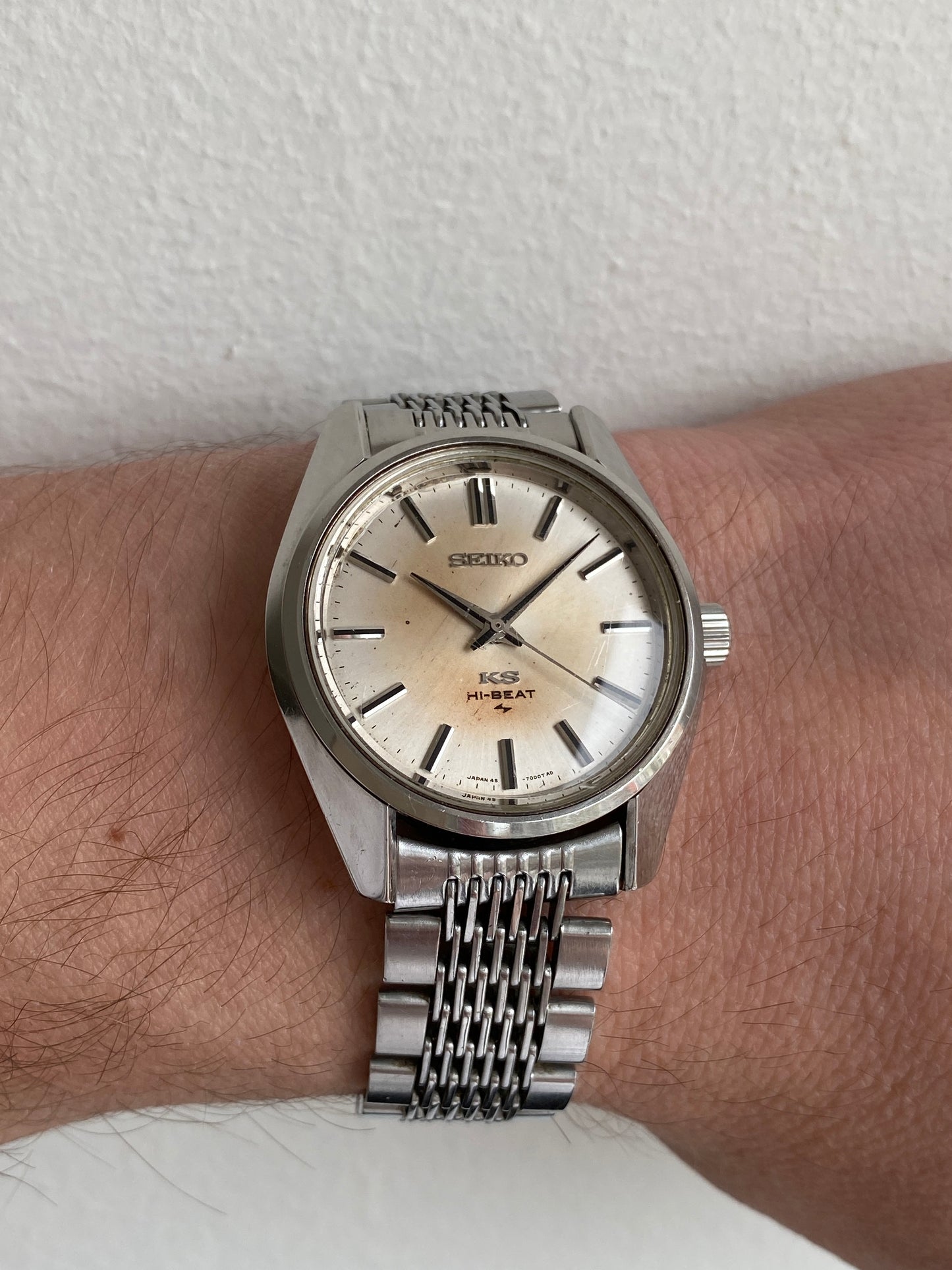
The watch The 45KS is one of the most appreciated King Seiko references, powered by the hand-wound high-beat movement that defines the line. This example stands out for its dial. The center has developed a warm, even patina that adds depth without feeling uneven or damaged. It’s the kind of aging that can’t be replicated, and no two will ever be the same.
The case is in mint condition and appears unpolished, with sharp lines that still hold their original definition. It wears exactly as it should, and the watch is running strong.
We’ve paired it with a period-correct LM bracelet that suits the case well, but the 18mm lug width leaves room for other strap options if preferred.
Condition is honest. The crystal shows light scratches. The dial has even patina through the center and a small area of corrosion near the top left. This is purely visual and does not affect performance. The caseback medallion is intact and well preserved, which is increasingly rare, as many have been worn down or lost over time.
A strong example where the sharpness of the case meets the character of a naturally aged dial.
Details The 45KS is powered by Seiko’s calibre 45, developed by Daini Seikosha in the late 1960s as a high-beat, hand-wound movement. It runs at 36,000 vibrations per hour, which gives it that fast, smooth sweep that sets it apart from most watches of the period.
The construction is slim and purposeful, with a thickness of around 3.5mm and a clean, well-organised layout. It features hacking seconds for precise setting and a solid, mechanical feel when winding.
This calibre was used in both King Seiko and Grand Seiko, with higher-grade versions adjusted to stricter standards. It marks the end of an era, just before quartz took over, when Seiko was pushing its mechanical watchmaking as far as it could go.