VAT included for EU orders.
Shipping calculated at checkout.
Couldn't load pickup availability
Specs
Model
Seiko Quartz Chronograph
Reference
7T34-7A10
Year
1989
Movement
Quartz
Dial
Gold
Case size
41mm
Lug width
20mm
Bracelet
B1705-J
Wrist size
Fits up to 20 cm
Condition
Excellent
Warranty
3 months
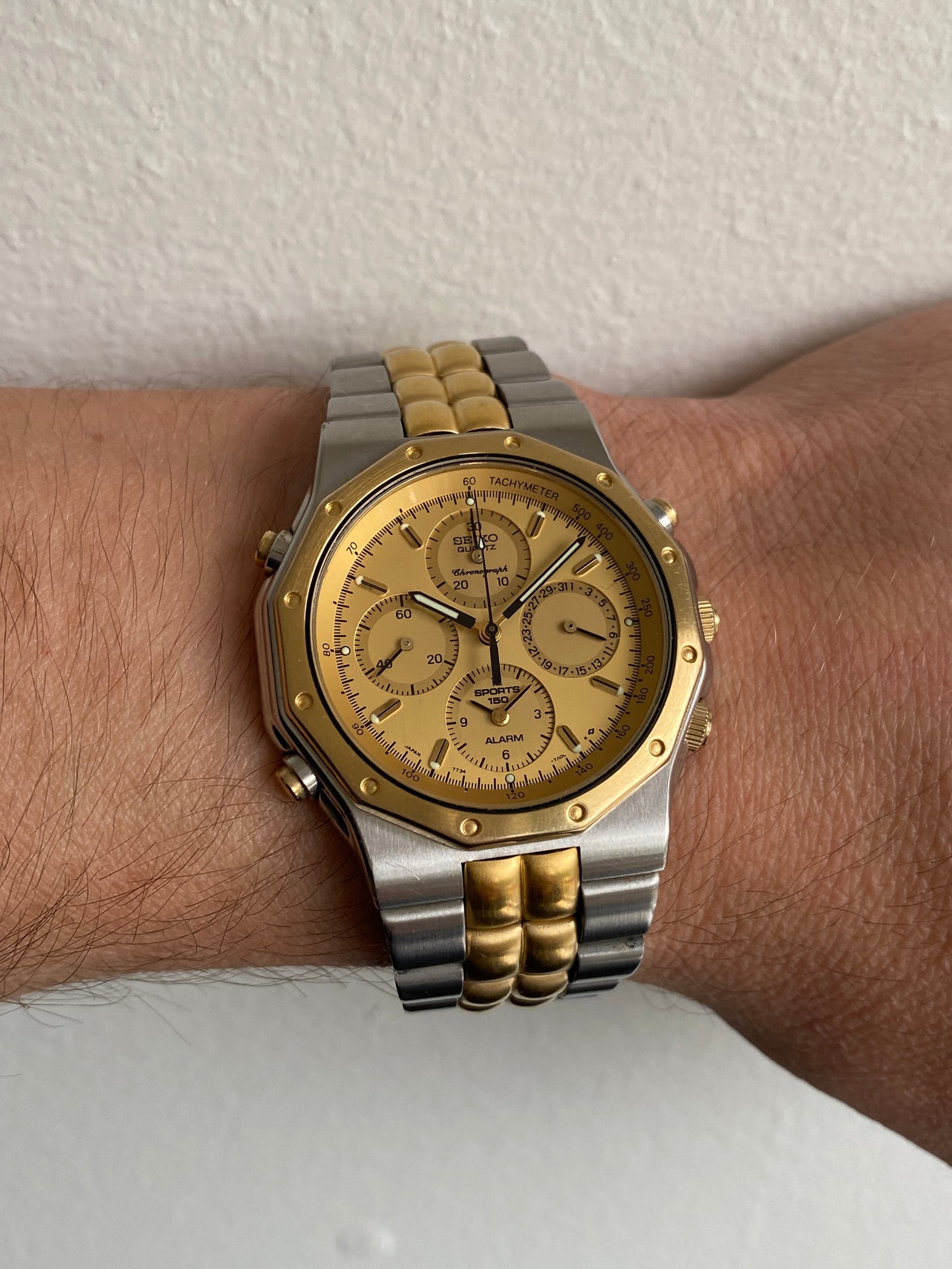
The watch Often nicknamed the “Seiko Royal Oak” due to its octagonal bezel and integrated bracelet design, the 7T34-7A10 stands well on its own as one of Seiko’s more distinctive early 1990s quartz chronographs. Produced in November 1989, this reference combines a sharp geometric case design with a warm two-tone finish and gold dial.
This example remains in exceptionally clean, unpolished condition with strong brushing throughout the case and bracelet. The gold-tone plating on the bezel, crowns and centre links is unusually well preserved, which is rarely seen on these models today. The bracelet is near full-length and the watch wears comfortably thanks to its compact proportions and integrated design. The crystal shows a few light scratches near the upper left area, while the bracelet has minor signs of wear consistent with careful use.
Powered by Seiko’s 7T34 quartz chronograph movement, the watch features a 1/5 second chronograph, alarm function and date display. The chronograph functions correctly with start, stop and instant reset operation. The subdials display chronograph minutes, running seconds, date indication and alarm setting. The alarm function is not audible.
Details The Seiko 7T34 is one of the brand’s most advanced quartz chronograph calibres from the late 1980s and early 1990s. Built in Japan, the movement combines a 1/5 second chronograph, alarm function, date display and tachymeter capability in a compact multi-register layout that became characteristic of Seiko’s sports chronographs of the era.
Unlike simpler quartz chronographs, the 7T34 uses independently driven stepper motors for its various functions, allowing precise operation and low battery consumption. The chronograph can measure up to 12 hours while maintaining standard timekeeping accuracy of approximately ±15 seconds per month.
The movement is also notable for its mechanical feel. The pushers have a firm, positive action, and the central chronograph seconds hand resets instantly and precisely to zero, something Seiko engineered particularly well during this period. It represents a period when Seiko heavily invested in technically ambitious analogue quartz movements before the market shifted toward simpler and cheaper modules.