VAT included for EU orders.
Shipping calculated at checkout.
Couldn't load pickup availability
Specs
Model
Seiko Quartz Type II
Reference
7546-7050
Year
1978
Movement
Quartz
Dial
Grey linen
Case size
36mm
Lug width
18mm
Bracelet
XYA041L
Wrist size
Fits up to 17 cm
Condition
New old stock
Warranty
3 months
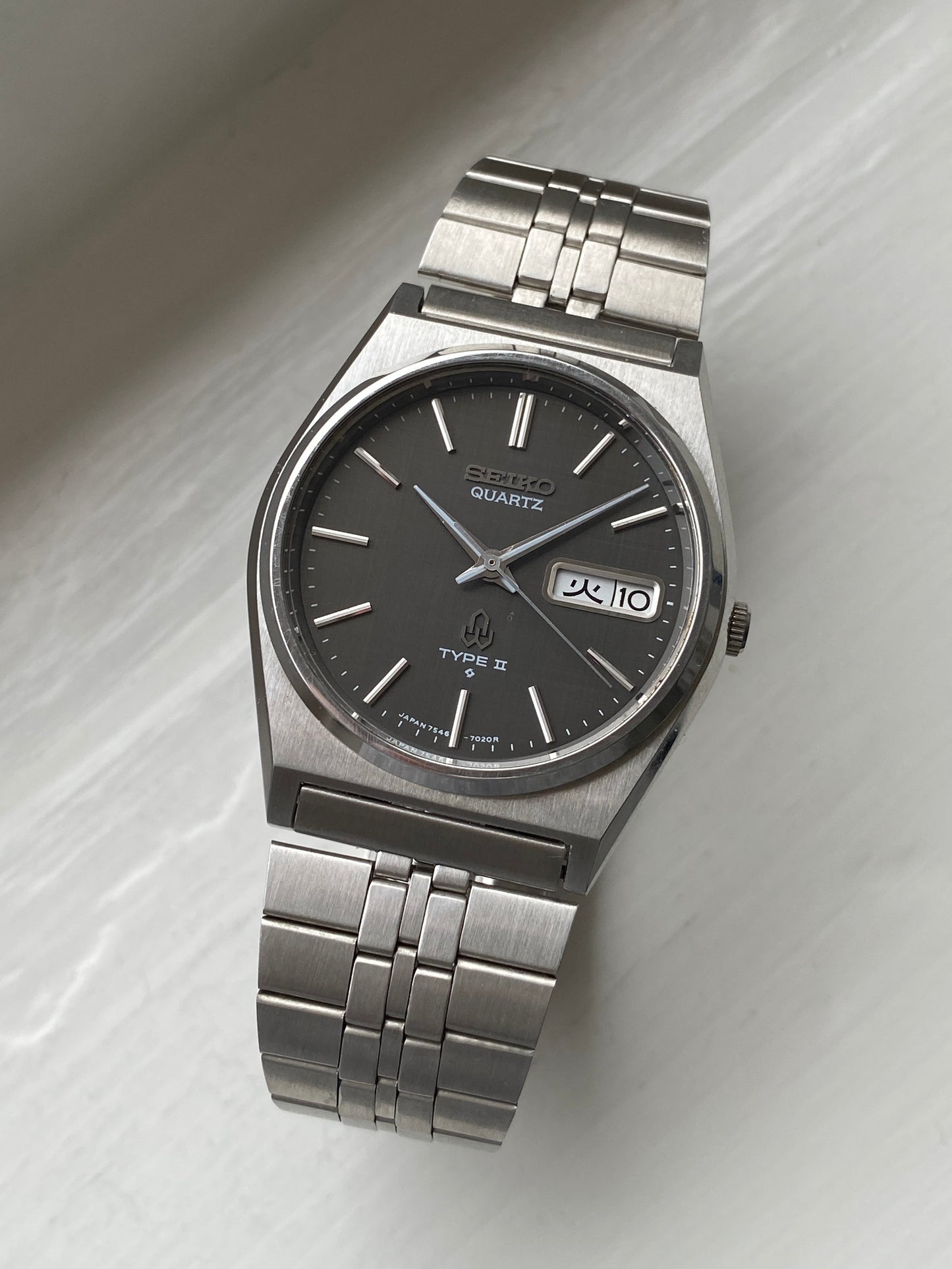
The watch Seiko Type II 7546-7050 from 1978 in true new old stock condition. Untouched since leaving the factory nearly half a century ago, it is even accompanied by its original price tag.
The watch features a stainless steel case paired with an anthracite dial with a very subtle linen texture. Sleek dauphine hands and applied indices give it an understated, elegant appearance that makes it equally suitable for everyday wear and more formal occasions. The day can be displayed in Japanese Kanji and English.
The original bracelet is fitted with an extension link, increasing its length by approximately 1 cm.
Having never been worn, the watch remains in exceptional condition. The only imperfections are a few light micro-scratches on the bezel from decades of storage.
Details The Seiko Type II, also known as the Seiko Quartz Type II, is a notable model in the history of quartz watches. Introduced in 1976, it represents Seiko's continued innovation following the success of the original Astron, the world’s first quartz watch. The Type II was part of Seiko's efforts to refine and advance quartz technology, offering improved accuracy and functionality.
Distinctive for its sleek design and advanced features, the Seiko Type II was one of the early examples of quartz watches. It showcased Seiko’s commitment to making cutting-edge technology accessible and reliable. The watch's design and precision helped further cement Seiko's reputation as a leader in the quartz revolution, contributing to the broader shift in the watch industry during the quartz crisis.
The quartz crisis The quartz crisis was a major turning point in the watch industry during the 1970s and 1980s, driven by the rise of quartz technology. Companies like Seiko led the way, offering watches that were more accurate, more affordable, and easier to maintain than traditional mechanical models.
With the launch of the first quartz wristwatch, the Astron, in 1969, Seiko showed the world what quartz could achieve. Swiss watchmakers, known for their mechanical craftsmanship, were slow to react and lost much of their market share. The crisis forced the Swiss industry to restructure and helped shape a future where traditional watchmaking and modern quartz innovation could exist side by side.